What Is Experiential Learning and Why It Is the Future of Business…
Experiential learning is the fastest-growing model in business education globally — and the most misunderstood in India. Here…

May 6, 2026
Written by Aastha Srivastava for Let’s Enterprise.
Entry level business roles still exist in 2026. They just do not feel very entry level anymore.
AI now handles much of the groundwork. What companies increasingly expect from freshers is something harder to automate: judgment. The key question is no longer whether a candidate can complete a task. It is whether they can move the work forward.
This article breaks down what that shift looks like in practice and what it means for students, parents, and employers hiring for entry level business roles.
While working on a client project with students, we were doing market research for a brand.
One student delivered a detailed report with clean data, structured slides, and a clear competitor breakdown. It was genuinely good work.
Then the client asked: What should we do next?
There was a pause.
Another student stepped in, used AI tools to quickly validate assumptions, checked pricing gaps, and suggested a clear next move backed by evidence.
Same project. Same inputs. Very different value.
That gap is exactly what companies are noticing when hiring for entry level business roles today.
The shift is not that AI is replacing entry level jobs. It is that AI is redefining what entry level means.
Earlier, freshers were hired to do the groundwork: research, data collection, and basic analysis. Today, much of that work can be done faster and cheaper with AI tools.
As repetitive work gets automated, expectations from new hires rise. Entry level business jobs are not disappearing. They are moving up the value chain, whether new graduates are ready or not.
Five years ago, companies asked: Can you do the task?
In 2026, they ask: Can you move the work forward?
That one shift changes how entry level business roles are evaluated.
Generating a report is easy now. Explaining what it means for the business is not. Entry level business professionals who can answer the question so what? stand out immediately.
AI has made everyone faster. But speed without clarity creates more work, not less. The real skill is knowing what actually matters and saying it clearly.
ChatGPT, Excel, and dashboards are quickly becoming baseline expectations, not differentiators. Strong candidates know how to combine tools to solve unclear, messy, real-world problems.
Role boundaries are getting softer. A marketing hire is expected to understand data. A business analyst is expected to think about customers. Employers now expect broader thinking from day one.
This is the biggest shift. Someone who can structure a problem well and communicate it clearly can add real value from their first week, even without years of experience.
If you are only learning how to complete tasks, you are preparing for work that is already being automated. Practice explaining why something matters, not just what you did.
Degrees still matter, but they are no longer enough on their own. Clear thinking, communication, and adaptability are what now help entry level business candidates get hired and promoted.
The best candidates are not always the most knowledgeable. They are often the ones who make things clearer instead of more complicated. That is what interviews should test for.
No. AI is eliminating tasks, not roles. Entry level business jobs are shifting toward judgment, communication, and problem-structuring rather than data gathering and report creation.
Beyond tool proficiency, companies now prioritize interpretation, cross-functional thinking, and clear communication. The ability to explain what a finding means for the business is often more valuable than the ability to produce the finding.
They are more competitive than before, not simply because there are fewer roles, but because the bar has moved. Candidates who can demonstrate judgment and business thinking from day one are significantly ahead.
Work on live projects. Practice making recommendations, not just completing deliverables. Learn to use AI tools, then learn to explain what the AI output actually means and what action should come next.
We keep saying AI is replacing jobs. What it is really replacing is low-value thinking.
It is exposing a clear divide in every entry level business role: some people use AI to finish work, while others use it to move work forward.
That difference will define entry level business careers in 2026 and beyond.
If this resonates, explore how Let’s Enterprise builds this kind of thinking through live projects at letsenterprise.in.


Experiential learning is the fastest-growing model in business education globally — and the most misunderstood in India. Here…

Most families calculate the tuition fee when budgeting for a BBA in India. The real cost is two…

Work-integrated education — earning income and building professional experience while studying for a degree — is growing fast…

Let's Enterprise is a pioneering educational institution that empowers students with hands-on business skills through its unique UG-M.E.D. program. With campuses in Pune and Goa, it bridges the gap between traditional learning and real-world experience, shaping the future of tomorrow's entrepreneurs.
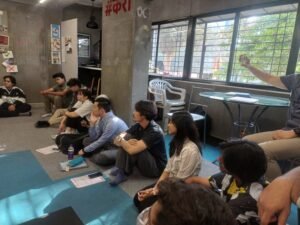
Discover how our first-year students are actively engaging in real-world business projects, guided by facilitator Sharjeel Shaikh.