What Is Experiential Learning and Why It Is the Future of Business…
Experiential learning is the fastest-growing model in business education globally — and the most misunderstood in India. Here…

May 25, 2026
Operations management is one of the most consistently in-demand career tracks in India — and one of the least talked about in school career counselling sessions. While students chase marketing and finance roles, operations professionals are quietly building careers that pay Rs 6–15 LPA within five years of graduation, with a ceiling that extends well into the crores for those who rise to COO and VP-Operations roles. The gap between demand and supply of good operations talent is wide — and that gap is an opportunity.
Managing the flow of goods, materials, and services from suppliers to customers. Negotiating with vendors, managing inventory, optimising logistics, and ensuring that the right thing is in the right place at the right time. Supply chain roles are in high demand across FMCG, e-commerce, manufacturing, and healthcare.
Identifying inefficiencies in how a business runs and fixing them. This involves data analysis, process mapping, stakeholder coordination, and change management. Process improvement professionals are the people who make organisations more profitable without increasing revenue — which is why they are valued at every level of a business.
Managing the operational systems that support a company’s people — from hiring workflows and onboarding to payroll systems, performance tracking, and organisational design. People ops roles combine analytical thinking with human coordination.
Managing relationships with external suppliers, agencies, and partners. Ensuring that commitments are met, contracts are honoured, and performance is tracked. This role requires both financial understanding and interpersonal skills.
At early-stage and growth-stage companies, operations roles are often the most varied and high-impact in the company. A startup operations professional might manage everything from hiring and vendor contracts to customer delivery systems and financial reporting — simultaneously. These roles build the broadest and fastest skill development available to early-career professionals.
Operations is fundamentally about managing complexity in real time — juggling vendors, deadlines, people, systems, and financial constraints simultaneously. These skills cannot be taught through case studies. They develop when a student is placed inside a real operational challenge and has to navigate it with real consequences.
This is why Let’s Enterprise’s operations track is built around live client projects and real apprenticeships. Students work on actual operational problems at real companies — tracking costs, coordinating vendors, managing timelines, and reporting to real stakeholders. By graduation, they have the operational vocabulary and the demonstrated track record that most graduates spend two or three post-graduation years trying to build.
The Working BBA programme runs for three years in Pune, awarding a UGC-approved BBA from DY Patil University or Pune University. Starts at 17. 50 seats for August 2026.
Build real operations skills before your first job.
Let’s Enterprise’s operations track puts you on live operational challenges from semester one. UGC-approved BBA + 4 apprenticeships + 13 client projects. 50 seats, August 2026.
Operations management as a career involves designing, managing, and improving the systems that allow a business to deliver its products or services. It spans supply chain, process improvement, people operations, vendor management, and business operations — across industries including e-commerce, FMCG, healthcare, manufacturing, and startups.
Entry-level operations roles in India pay Rs 3.5–6 LPA. Operations managers with 3–5 years of experience earn Rs 8–16 LPA. Senior roles and COO positions pay Rs 30 LPA and above. The track rewards breadth of exposure and the ability to manage complex systems under pressure.
A BBA or B.Com degree provides the business foundation for operations roles. However, real-world exposure — through internships, apprenticeships, or live project work — is as important as the degree itself. Operations roles test your ability to manage real complexity, which textbooks cannot fully prepare you for.
Yes. Operations is a high-demand career with a strong salary trajectory and a wide ceiling. As businesses scale and supply chains grow more complex, operations talent is consistently in short supply — making it one of the best career tracks for students who can demonstrate real operational skills.
The most effective path is a business degree combined with real operational exposure — not just classroom theory. Programmes like Let’s Enterprise’s Working BBA include a dedicated operations track with live client projects and apprenticeships, giving students documented operational experience before graduation.


Experiential learning is the fastest-growing model in business education globally — and the most misunderstood in India. Here…

Most families calculate the tuition fee when budgeting for a BBA in India. The real cost is two…
Work-integrated education — earning income and building professional experience while studying for a degree — is growing fast…

Let's Enterprise is a pioneering educational institution that empowers students with hands-on business skills through its unique UG-M.E.D. program. With campuses in Pune and Goa, it bridges the gap between traditional learning and real-world experience, shaping the future of tomorrow's entrepreneurs.
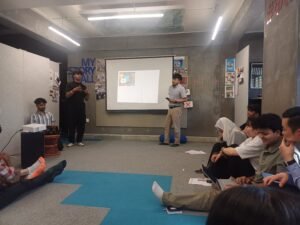
Discover how our first-year students are actively engaging in real-world business projects, guided by facilitator Sharjeel Shaikh.