What Is Experiential Learning and Why It Is the Future of Business…
Experiential learning is the fastest-growing model in business education globally — and the most misunderstood in India. Here…

May 25, 2026
Most Indian students prepare for job interviews by revising technical concepts, memorising company facts, and polishing their resume. Hiring managers are evaluating something different: whether you can think clearly under pressure, communicate with precision, take ownership of a problem, and function in an environment where nobody will tell you exactly what to do. Understanding this gap — between what you prepared for and what is being tested — is the single most useful thing you can know before entering the job market.
Before any interview, a recruiter or ATS system screens resumes. At this stage, two things matter: a minimum CGPA threshold (typically 6.0–6.5) and evidence of relevant real-world activity. Internship names, project titles, and measurable outcomes are what a recruiter scans for in 15–30 seconds. A resume that leads with real work — named companies, specific roles, measurable results — consistently outperforms one that leads with academic scores and extracurricular activities.
The first-round interview at most Indian companies tests four things above all else:
Can you explain something complex in plain language? Can you answer a question directly without padding? Hiring managers decide within the first 3 minutes whether your communication is professional-grade. This is not about English fluency — it is about structure, precision, and the ability to get to the point.
Almost every first-round interview includes a question of the form: “Tell me about a situation where you had to solve a problem.” Candidates who have real examples — specific, detailed, with real stakes — answer this confidently. Candidates who have only case studies and classroom projects struggle to provide the specificity that registers as credible.
Hiring managers pay close attention to whether candidates use “I” or “we” when describing their work. Candidates who took ownership — who made decisions, who followed through, who were accountable for the outcome — are distinguished from candidates who participated in team projects but deferred all responsibility to others.
Have you done anything because you chose to — not because it was required? A side project, a freelance assignment, a self-initiated piece of research. Companies want to hire people who are self-directed — and this is one of the clearest indicators available to a hiring manager in a 30-minute conversation.
For roles with specific functional requirements, candidates face a technical or case round testing the skill the job requires — a marketing brief analysis, a financial model review, an operations scenario. Candidates who have done real work of this type perform significantly better in these rounds than those who have only studied the theory. The difference is visible immediately to any experienced interviewer.
Working BBA graduates enter interviews with 13 documented client projects and 4 real apprenticeships to discuss. Every interview question about “a situation where you had to solve a problem” has a real, specific, defensible answer. Every technical question connects to actual work done — not a case study. And every conversation about ownership and initiative reflects what has actually been practised, not what has been rehearsed.
The programme gives students the UGC-approved BBA from DY Patil University or Pune University that passes every screening filter, and the real-work evidence that wins every interview room. Starts at 17, 50 seats for August 2026 in Pune.
Graduate with real answers for every interview question.
Let’s Enterprise’s Working BBA: 13 live client projects, 4 real apprenticeships, and a UGC-approved degree. Real experience for every interview scenario. 50 seats, August 2026.
Most Indian companies use a multi-stage process: resume screening (CGPA threshold + real-work evidence), first-round behavioural interviews (communication, ownership, initiative, real-work examples), functional or case rounds (skill demonstration), and HR fit interviews. The biggest differentiator across all stages is documented real-work experience with specific, measurable outcomes.
Hiring managers look for: clear communication under pressure, specific real-work examples demonstrating problem-solving and ownership, functional skills that create immediate value, and signals of self-direction (having done things without being required to). Academic scores are a minimum threshold, not a differentiator above it.
Extremely important in 2026. The India Skills Report consistently shows that fewer than half of management graduates are considered immediately employable. The distinguishing factor between those who are and those who are not is overwhelmingly real-work experience — documented, specific, with real accountability and real outcomes.
Common first-round questions include: “Tell me about yourself” (tests communication clarity), “Tell me about a challenge you solved” (tests real-work evidence and ownership), “Why do you want to work here?” (tests preparation and genuine interest), and “Where do you see yourself in 5 years?” (tests direction and ambition). All favour candidates with real work to discuss.
Build real work experience before graduation — through internships, apprenticeships, freelance projects, or work-integrated degree programmes. Develop specific functional skills in marketing, finance, or operations that create immediate value. Practice articulating your work clearly and specifically. Enter interviews with real examples, not hypothetical ones.


Experiential learning is the fastest-growing model in business education globally — and the most misunderstood in India. Here…

Most families calculate the tuition fee when budgeting for a BBA in India. The real cost is two…
Work-integrated education — earning income and building professional experience while studying for a degree — is growing fast…
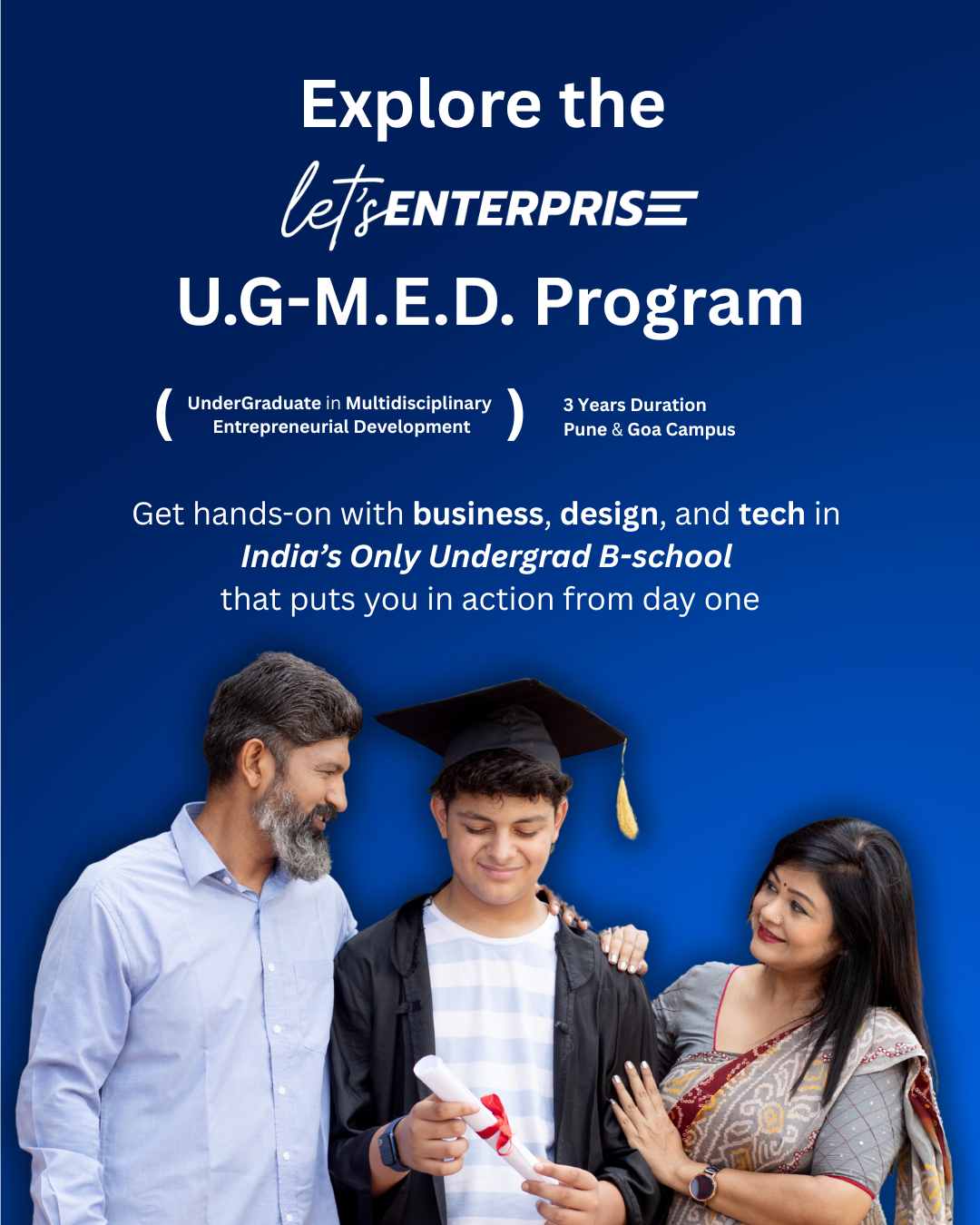
Let's Enterprise is a pioneering educational institution that empowers students with hands-on business skills through its unique UG-M.E.D. program. With campuses in Pune and Goa, it bridges the gap between traditional learning and real-world experience, shaping the future of tomorrow's entrepreneurs.
Discover how our first-year students are actively engaging in real-world business projects, guided by facilitator Sharjeel Shaikh.