What Is Experiential Learning and Why It Is the Future of Business…
Experiential learning is the fastest-growing model in business education globally — and the most misunderstood in India. Here…

May 25, 2026
Every job posting in India lists “good communication skills” as a requirement — and almost no college programme teaches what employers actually mean by it. The phrase has been used so loosely that it has lost precise meaning for most students. To employers, business communication is not about English fluency. It is not about confidence. It is about the ability to take a complex situation, form a clear view about it, and deliver that view in a way that makes the listener more capable of acting. That is a specific, learnable, and practice-dependent skill — and one of the most directly impactful on career trajectory.
The ability to take a messy situation and organise it into a clear, logical structure before speaking or writing. The MECE principle (Mutually Exclusive, Collectively Exhaustive), the Pyramid Principle (conclusion first, then supporting evidence), and simple problem-solution-recommendation frameworks all operationalise this. Candidates who organise their thoughts before speaking — even briefly — are immediately distinguishable from those who think out loud through their answer.
The ability to look at a number, a report, or a dataset and explain in plain language: what does this mean, why does it matter, and what should we do because of it? This is consistently flagged as the biggest communication gap in fresh hires across finance, marketing, and operations roles. Numbers that do not lead to a recommendation are just numbers.
The ability to say what needs to be said in as few words as possible without losing accuracy or nuance. Senior professionals in every industry value time above almost everything else. A candidate who takes three minutes to answer a question that deserved thirty seconds signals poor judgment about what matters, regardless of how good the content was.
The ability to adjust how you communicate based on who you are communicating with. A detailed technical explanation for a peer is appropriate. The same explanation for a business leader is a waste of both people’s time. Reading the room and calibrating the message is a skill that develops through repeated real interactions with varied stakeholders — not through classroom practice.
Hiring managers test communication through three mechanisms: behavioural questions (“Tell me about a time when…”), case or analytical questions (“Here is a business problem — walk me through how you’d approach it”), and conversational observation (how you ask questions, how you respond to pushback, whether you listen before answering).
Candidates who have had real conversations with real stakeholders — clients, managers, colleagues with more experience — are immediately better at all three. They have already learned, through real feedback, what works and what does not.
Communication skills develop through practice in contexts where the quality of communication has real consequences. Writing a client brief that a real client will read. Presenting a financial analysis to a manager who will make a real decision with it. Recommending a change to an operational process and defending that recommendation under questioning.
This is why Let’s Enterprise’s Working BBA builds communication through real client projects and apprenticeships — not through presentation assignments and role plays. Students communicate to real stakeholders about real work throughout the programme. By graduation, they have communicated in dozens of real professional contexts — which means they have already learned what works, what doesn’t, and how to adjust.
The programme awards a UGC-approved BBA from DY Patil University or Pune University, starts at 17, and has 50 seats for August 2026 in Pune.
Build the communication skills employers actually test.
Let’s Enterprise’s Working BBA develops real professional communication through 13 live client projects and 4 apprenticeships — with real stakeholders and real stakes. UGC-approved degree. 50 seats, August 2026.
In an Indian job interview, business communication means the ability to think clearly, structure your response logically, answer questions directly without excessive hedging, translate data or analysis into actionable recommendations, and adjust your communication style based on your audience. It is tested through how you answer behavioural and case questions, not just by your fluency.
The most effective way is through real practice in contexts where communication quality has consequences — client interactions, professional presentations, stakeholder meetings. The skill develops fastest when you receive real feedback from real professionals who will tell you honestly when your communication missed the mark. Formal communication courses help with foundations but cannot replicate this.
No. Business communication is about structured thinking, clarity, concision, and the ability to translate information into decisions — regardless of language. Many of India’s best business communicators are more effective in Hindi or regional languages for certain audiences. English fluency is a factor in many corporate environments but is far less important than the ability to think clearly and communicate precisely.
Commonly valued frameworks include the Pyramid Principle (lead with the conclusion, support with evidence), MECE thinking (structured, non-overlapping categorisation), and the STAR method for behavioural answers (Situation, Task, Action, Result). More important than any framework is the habit of thinking before speaking and leading with your conclusion rather than building up to it.
Communication skills have a disproportionate impact on career trajectory in India. They affect first-round hiring success, impression on senior stakeholders, ability to influence decisions, and suitability for leadership roles. Research consistently shows that people with strong structured communication skills are promoted faster and earn more than peers with equivalent technical skills but weaker communication.


Experiential learning is the fastest-growing model in business education globally — and the most misunderstood in India. Here…

Most families calculate the tuition fee when budgeting for a BBA in India. The real cost is two…
Work-integrated education — earning income and building professional experience while studying for a degree — is growing fast…

Let's Enterprise is a pioneering educational institution that empowers students with hands-on business skills through its unique UG-M.E.D. program. With campuses in Pune and Goa, it bridges the gap between traditional learning and real-world experience, shaping the future of tomorrow's entrepreneurs.
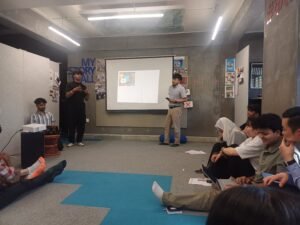
Discover how our first-year students are actively engaging in real-world business projects, guided by facilitator Sharjeel Shaikh.