What Is Experiential Learning and Why It Is the Future of Business…
Experiential learning is the fastest-growing model in business education globally — and the most misunderstood in India. Here…

May 25, 2026
The most important education decisions after Class 12 in India are made by parents — but they are made using assumptions formed a generation ago. The rules that held for the 1990s and 2000s have shifted. College brand names carry less weight than they used to. Degrees are necessary but no longer sufficient. The gap between what universities teach and what employers need has widened. And the options available to a student finishing 12th today are genuinely different from what was available when today’s parents were choosing their path. This is an honest guide — written for families who want to make a good decision, not a comfortable one.
In the 1990s and early 2000s, graduating from a well-known college was a meaningful signal to employers — partly because the signalling value was high relative to the competition. In 2026, every city has dozens of colleges with good names. Employers have stopped treating brand name as a proxy for ability and started asking for demonstrated skills instead. The graduate who can show real work experience, a portfolio of outcomes, and specific functional skills is consistently preferred over the graduate from a better-known college who cannot.
India produces over 1.5 million management graduates per year. A degree is now the baseline — not the differentiator. The India Skills Report has repeatedly shown that fewer than 50% of management graduates are considered immediately employable by hiring companies. Having a degree is necessary. It is not sufficient. What differentiates employable graduates is the real-world competence built alongside or through the degree.
The traditional Indian path — undergraduate degree, then MBA at 23–25 to get real skills and placement — made sense when MBA programmes delivered strong placement outcomes. In 2026, MBA ROI varies enormously. A student who starts building real professional experience at 17 enters the job market with a five-year head start on the one who waits for an MBA at 23. The best investment in a business career is real professional experience, started as early as possible.
Three things consistently predict strong career outcomes for young professionals in India in 2026:
The question to ask about any programme is: does it deliver all three?
Let’s Enterprise’s Working BBA in Pune delivers all three. Students earn a UGC-approved BBA degree from DY Patil University or Pune University — valid for government employment, further education, and professional purposes. They complete 4 real apprenticeships and 13 live client projects across Marketing, Finance, and Operations — building documented professional experience before the age of 21. And they develop specific, demonstrable functional skills through real work rather than classroom theory.
The programme starts at 17, immediately after Class 12, with 50 seats for the August 2026 cohort. It gives students the credential, the experience, and the skills in a single three-year programme — rather than spreading them across an undergraduate degree, an MBA, and years of post-graduation experience building.
Give your child the credential and the head start.
Let’s Enterprise’s Working BBA: UGC-approved degree from DY Patil University or Pune University + 4 real apprenticeships + 13 live client projects. Starts at 17. 50 seats, August 2026.
The best option in 2026 combines a UGC-recognised degree with structured real-world work experience — not one or the other. Programmes that deliver only classroom education leave graduates without the practical skills employers demand. Programmes without UGC recognition risk credential validity. The combination of both, starting at 17, represents the strongest possible career foundation.
It depends entirely on what the programme delivers beyond the credential. A private college BBA is worth the premium if it provides superior placement connections, real-world project exposure, mentorship from industry professionals, and functional skill-building that a government college cannot match. If the premium pays only for a brand name and slightly better infrastructure, the ROI is questionable.
CA is the right choice for students with clear interest in audit, taxation, and financial compliance who are prepared for a 5–6 year qualification process with very low pass rates. BBA is better for students who want broader business careers in management, marketing, operations, or startups. Neither is universally superior — the right choice depends entirely on career direction.
A UGC-recognised degree remains important for government employment, further education (especially abroad), certain professional licensing requirements, and as a baseline credential for most corporate employers. While some private certifications carry hiring weight in specific industries, a UGC-approved undergraduate degree remains the most versatile and secure credential for long-term career flexibility.
Look for three things: UGC recognition of the degree awarded, structured real-world work experience built into the programme (not just internships as add-ons), and specific skill development in high-demand business functions. Programmes that deliver all three consistently produce graduates who are more employable, more highly paid, and more career-ready than those that deliver only credentials.


Experiential learning is the fastest-growing model in business education globally — and the most misunderstood in India. Here…

Most families calculate the tuition fee when budgeting for a BBA in India. The real cost is two…
Work-integrated education — earning income and building professional experience while studying for a degree — is growing fast…

Let's Enterprise is a pioneering educational institution that empowers students with hands-on business skills through its unique UG-M.E.D. program. With campuses in Pune and Goa, it bridges the gap between traditional learning and real-world experience, shaping the future of tomorrow's entrepreneurs.
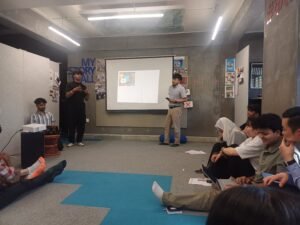
Discover how our first-year students are actively engaging in real-world business projects, guided by facilitator Sharjeel Shaikh.