What Is Experiential Learning and Why It Is the Future of Business…
Experiential learning is the fastest-growing model in business education globally — and the most misunderstood in India. Here…

May 25, 2026
The relationship between CGPA and employment outcomes in India has never been weaker than it is in 2026. This is not an opinion — it is what hiring managers, talent acquisition heads, and founders across India’s corporate and startup ecosystem report consistently. The India Skills Report, the Aspiring Minds National Employability Report, and hiring surveys across industries all point to the same conclusion: fewer than half of India’s management graduates are considered immediately employable, and the gap is not explained by grades. Students with excellent CGPAs fail first-round interviews. Students with average CGPAs who have built real skills get hired at premium salaries. Understanding why this is happening — and what to do about it — is the most practically valuable thing a student can know right now.
Fifteen years ago, CGPA was a reasonable shortcut for employers. The number of graduates was smaller, the top students were genuinely harder to identify, and the correlation between academic performance and workplace capability was stronger. That correlation has weakened for three reasons.
First, academic grade inflation has made high CGPAs increasingly common — reducing their signal value. When 40% of a graduating class scores 8.5 or above, the number no longer distinguishes top performers.
Second, the skills that examinations reward (recall, structured answering, time management under test conditions) have less overlap with the skills that jobs require (ambiguity tolerance, initiative, real-time decision-making, interpersonal influence) than anyone in the education system finds comfortable to admit.
Third, AI tools have made information retrieval trivially easy — which means the knowledge component that exams test is now even less valuable as a workplace differentiator. What AI cannot do is exercise judgment, manage relationships, and take ownership of an outcome — and that is precisely what employers are now screening for.
Based on consistent patterns from hiring managers across Indian industries, here is what actually determines first-round success in 2026:
CGPA is checked as a threshold (most companies screen out below 6.0 or 6.5) — not as a differentiator above it. Passing the threshold is necessary. Exceeding it delivers almost no additional advantage.
The graduates who get the best first jobs in India in 2026 — in terms of quality of organisation, role, and salary — are overwhelmingly those who have real work experience before graduation. Internships, freelance projects, student businesses, apprenticeships — any form of documented real work where the outcomes were real and the accountability was real.
This is the core principle behind Let’s Enterprise’s Working BBA. Students are not measured on exam scores. They are measured on the quality of their real work — client projects completed, apprenticeship performance, operational deliverables. By graduation, they have 13 documented client projects and 4 real apprenticeships to discuss in interviews — not a CGPA.
The programme awards a UGC-approved BBA from DY Patil University or Pune University, starts at 17, and has 50 seats for August 2026 in Pune.
Graduate with real work to show — not just a number.
Let’s Enterprise’s Working BBA: 13 live client projects, 4 real apprenticeships, and a UGC-approved degree. The portfolio that gets interviews — not the CGPA. 50 seats, August 2026.
CGPA matters as a minimum threshold — most companies screen out candidates below 6.0 or 6.5. Above that threshold, it carries very little additional weight with most employers. What matters more is demonstrated real-work experience, specific functional skills, and the ability to show and articulate actual outcomes from real projects.
Most Indian companies set a minimum CGPA cutoff between 6.0 and 6.5 out of 10 for entry-level roles. Some consulting firms and investment banks maintain higher cutoffs of 7.0–7.5. Above these thresholds, CGPA generally does not differentiate candidates — real skills and experience become the deciding factors.
Yes — a 7 CGPA passes most corporate screening thresholds. Whether it translates into strong placement depends almost entirely on what you have built alongside your CGPA: internships, projects, demonstrable skills, and the ability to articulate real outcomes. A 7 CGPA with strong real-world experience will consistently outperform a 9 CGPA with no work to show.
High-CGPA students struggle when they have optimised for the wrong metric. Examinations reward recall, structured answering, and time management under test conditions. Jobs reward initiative, ambiguity tolerance, interpersonal skill, and real decision-making. Students who spent three years perfecting exam performance without building real-work skills arrive at interviews unable to answer “tell me about a problem you solved at work.”
Focus on building real work experience — through internships, apprenticeships, freelance projects, or programmes that integrate real client work into the degree. Build specific functional skills that create immediate value for an employer. Develop the communication ability to articulate what you have done and what you learned from it. These three things drive career outcomes far more powerfully than academic grades above the screening threshold.


Experiential learning is the fastest-growing model in business education globally — and the most misunderstood in India. Here…

Most families calculate the tuition fee when budgeting for a BBA in India. The real cost is two…
Work-integrated education — earning income and building professional experience while studying for a degree — is growing fast…

Let's Enterprise is a pioneering educational institution that empowers students with hands-on business skills through its unique UG-M.E.D. program. With campuses in Pune and Goa, it bridges the gap between traditional learning and real-world experience, shaping the future of tomorrow's entrepreneurs.
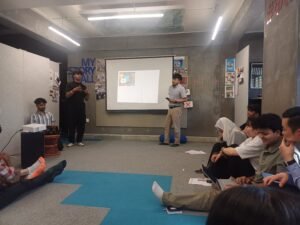
Discover how our first-year students are actively engaging in real-world business projects, guided by facilitator Sharjeel Shaikh.