What Is Experiential Learning and Why It Is the Future of Business…
Experiential learning is the fastest-growing model in business education globally — and the most misunderstood in India. Here…

May 23, 2026
India now has a small but serious category of experiential business schools — programs built around doing real work, not passively absorbing theory. Before you choose one, here is exactly what each program offers, where each falls short, and what questions will separate a smart investment from an expensive mistake.
Traditional MBA programs teach business through cases and textbooks. Experiential schools — at least in theory — teach through live projects, founder mentorship, and direct market exposure. The best versions compress years of on-the-job learning into a structured program. The worst versions add a few industry visits to an otherwise conventional curriculum and call it “experiential.”
The single most important question to ask any experiential school: is the real-world work structural (baked into every week of the program) or add-on (a module, a capstone, a guest lecture series)?
Masters Union reports an average placement salary of Rs 33 LPA, making it one of the highest-reported outcomes among non-IIM business programs in India.
The critical caveat: Masters Union holds no UGC recognition. The PGP TBM is a private certification, not a government-recognised degree. For students or parents who require a UGC-approved credential — for government jobs, further education abroad, or regulatory requirements — this is a disqualifying factor, not a footnote.
Mesa School’s backing by Kunal Shah and Elevation Capital signals genuine venture-ecosystem credibility — but credibility from backers is not the same as a verified placement track record.
Let’s Enterprise is the only program in this category that offers a UGC-approved BBA degree — from DY Patil University or Pune University — alongside structured real-world work from the very first semester, starting at 17, not 22.
Where Masters Union and Mesa School are postgraduate programs for students who have already completed a degree, Let’s Enterprise is built for students finishing Class 12. The programme compresses what most people spend years trying to acquire — real business exposure, a degree, and a track record — into three years, starting immediately after school.
The structure is deliberately different from both conventional colleges and postgraduate experiential programs. Students are not placed in internships after completing theory. They begin working on live client projects and apprenticeships from the first semester — which means by the time they graduate, they have 15 months of documented real-work experience, three business specialisations, and 13 client deliverables.
The degree from DY Patil University or Pune University means none of this comes at the cost of credential validity — it works for government employment, further education abroad, and any context where a recognised undergraduate qualification is required.
Neither Masters Union nor Mesa School holds UGC recognition — which matters for government employment, foreign university admissions, and professional licensing. Let’s Enterprise students graduate with a UGC-approved BBA from DY Patil University or Pune University — so they get real-world learning without sacrificing credential validity.
The right question to ask any program: “In a typical week, how many hours does a student spend on live commercial work?” At Let’s Enterprise, the answer is built into the programme design — apprenticeships and client projects run across all three years, not as a capstone or optional module. Real work is the curriculum, not a supplement to it.
At both Masters Union and Mesa School, students must first complete a standard undergraduate degree before enrolling — meaning experiential learning begins at 22 at the earliest. At Let’s Enterprise, it begins at 17. That four-to-five year head start compounds significantly by the time a student enters the job market.
The postgraduate experiential path — three years of undergraduate college, then Rs 24-34 lakhs for a one-year program — is a long and expensive route to real-world learning. Let’s Enterprise combines the degree and the real-world experience into a single three-year programme, removing the need to pay twice and wait five years.
Both Masters Union and Mesa School are postgraduate programs. If you are finishing Class 12 today, neither is immediately available to you.
A student who begins structured real-world business learning at 18 enters the professional market with a compounding advantage that no postgraduate program, however well-designed, can fully replicate.
No. Masters Union’s PGP TBM is a private post-graduate programme and does not carry UGC recognition. It is a valuable credential within the corporate and startup hiring market, but it does not function as a government-recognised degree for purposes of government employment, certain professional licences, or some foreign university admissions.
No. Both Masters Union and Mesa School are post-graduate programmes requiring prior undergraduate completion. Students finishing Class 12 who want experiential business education from day one should look at undergraduate programmes specifically designed around real-work learning, such as Let’s Enterprise’s Working BBA.
Finishing Class 12? Start your business career now — not at 22.
Let’s Enterprise’s Working BBA gives you a UGC-approved degree, 4 real apprenticeships, and 13 live client projects — all three years, starting at 17. 50 seats. August 2026 cohort.


Experiential learning is the fastest-growing model in business education globally — and the most misunderstood in India. Here…

Most families calculate the tuition fee when budgeting for a BBA in India. The real cost is two…
Work-integrated education — earning income and building professional experience while studying for a degree — is growing fast…
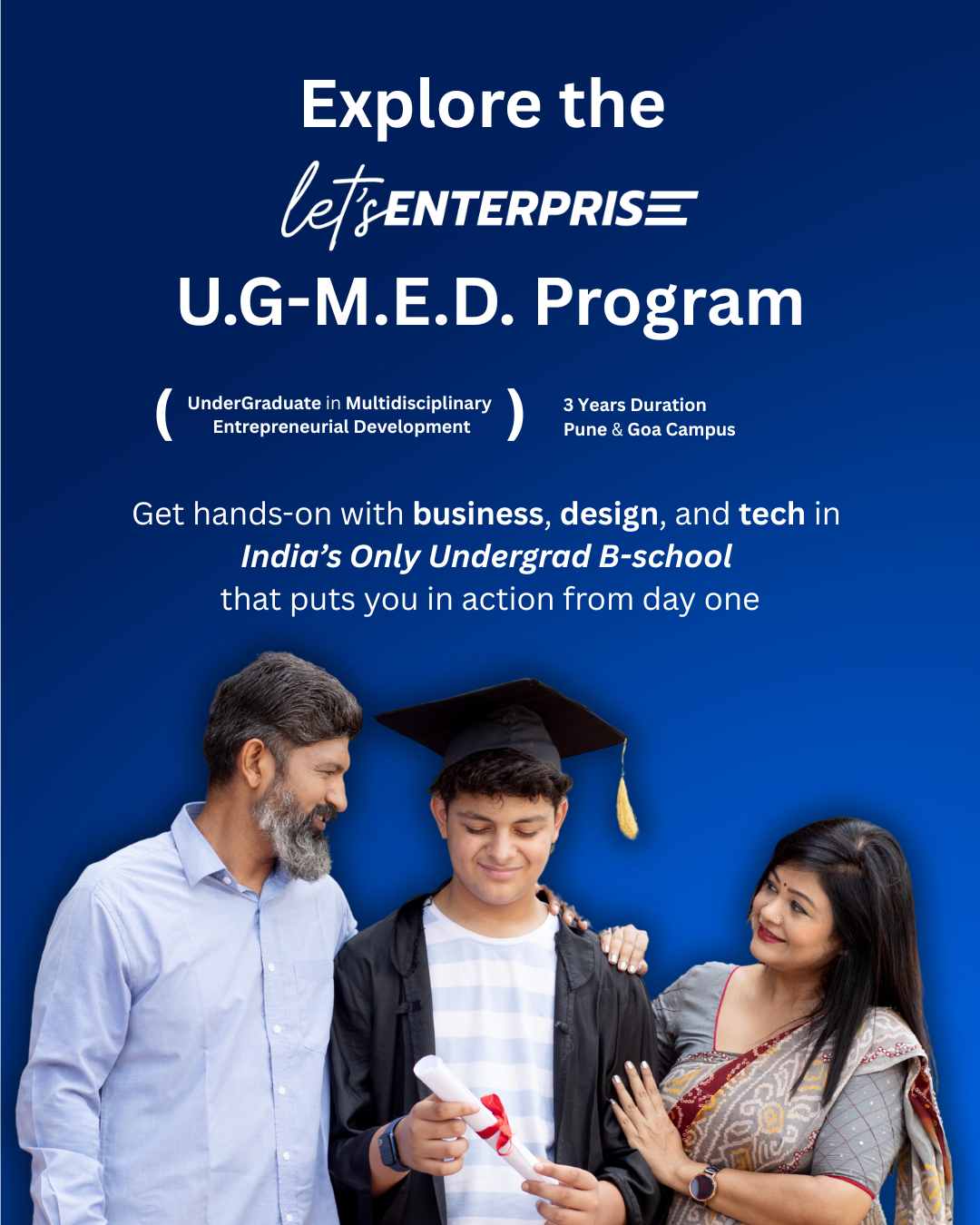
Let's Enterprise is a pioneering educational institution that empowers students with hands-on business skills through its unique UG-M.E.D. program. With campuses in Pune and Goa, it bridges the gap between traditional learning and real-world experience, shaping the future of tomorrow's entrepreneurs.
Discover how our first-year students are actively engaging in real-world business projects, guided by facilitator Sharjeel Shaikh.