What Is Experiential Learning and Why It Is the Future of Business…
Experiential learning is the fastest-growing model in business education globally — and the most misunderstood in India. Here…

May 23, 2026
Food delivery and EdTech appear to be completely different industries. They fail for the exact same reason. Both operate on razor-thin margins where a single operational breakdown — a delayed mentor response, a missed delivery window — triggers churn that is nearly impossible to reverse. The real product in both industries is not food or education. It is operational consistency at scale.
Written by Aastha Srivastava, Let’s Enterprise | May 18, 2026
Food delivery crossed $150 billion globally, with its share of food service spending jumping from 9% in 2019 to 21% in 2024. Yet the average contribution margin per order hovers around 3% (McKinsey). At 3%, every inefficiency — a wrong bag, a late handoff, a support ticket — wipes profit instantly.
EdTech faces the same math. World-class content means nothing if students disappear by Week 2. Retention is not a feature. Retention is the entire business model.
After working inside a practical learning programme and running student cohorts, the structural similarities became impossible to ignore: attendance patterns that mirrored customer retention dashboards, mentor response delays that created the same frustration as delayed food orders, and poor onboarding that dropped engagement just as a bad restaurant experience kills repeat customers.
Consumers experience “easy.” Teams experience controlled chaos. Every 10-minute delivery promise creates simultaneous pressure across dark stores, rider allocation, inventory prediction, and customer support. In EdTech, every student session requires mentor quality, engagement tracking, behavioural intervention, and operational follow-through — at the same time. The smoother the product feels, the harder someone is working behind it.
Food delivery platforms track prep time and rider efficiency. EdTech platforms track watch time, drop-offs, and attendance. Dashboards alone mean nothing. Student engagement recovers not because an algorithm detects a problem — but because one person follows up with empathy at exactly the right moment.
Neither industry scales through acquisition alone. A user ordering three times a week, or a student showing up consistently — that is what keeps the economics alive. Acquiring new users is expensive. Retaining them creates compounding value.
Delivery riders, support agents, mentors, teaching assistants, operations coordinators — they never appear in ads. One research paper described food delivery infrastructure as “a patchwork of disparate technical systems held together by human intervention.” That description applies equally to EdTech operations.
Dark stores place inventory closer to demand to cut delivery time. Learning dashboards place interventions closer to student behaviour to cut learning friction. Different industries. Same philosophy: predict the gap before the user feels it.
Technology alone rarely fixes broken systems. Human coordination still does.
We glorify coding, marketing, finance, and AI. Companies quietly and desperately need people who can manage systems, coordinate chaos, and create smooth experiences across multiple moving parts. Degrees and certifications are easy to filter. Execution under pressure is not.
The most underrated career skill in 2026 is not a programming language or a marketing framework. It is operational maturity — the ability to keep complex systems running when multiple things go wrong at once.
This is exactly why practical learning at Let’s Enterprise focuses on real projects, operational exposure, and industry interaction — not classroom theory alone. Students who understand coordination and follow-through do not just find jobs. They become the people teams cannot afford to lose.
The question worth sitting with: Are we preparing young professionals to build impressive products? Or to actually run complex systems that work?
Want to build operational skills that matter?
Let’s Enterprise’s Working BBA gives you 4 real apprenticeships, 13 live client projects, and an industry-facing career — starting at 17.
EdTech companies struggle with retention because they invest heavily in content acquisition and marketing but underinvest in the operational infrastructure — mentors, engagement tracking, timely interventions — that keeps students engaged past the first two weeks. The economics mirror food delivery: retention is the actual business model, and losing a student early is almost impossible to reverse.
Operational excellence in education means delivering consistent, frictionless learning experiences at scale — ensuring mentor response times, student onboarding quality, engagement monitoring, and behavioural interventions all work simultaneously. It is the same discipline that food delivery companies use to fulfil thousands of orders per hour reliably.
Companies in 2026 most need people with operational maturity — the ability to manage systems, coordinate multiple teams, and sustain smooth user experiences under pressure. Technical skills are table stakes for hiring; the ability to execute and coordinate across complex systems is what makes someone indispensable.
Experiential learning places students inside real business operations — running actual client projects, managing stakeholder relationships, and solving live problems — rather than studying case studies in a classroom. Programmes like Let’s Enterprise’s Working BBA use apprenticeships and live projects to build the operational maturity that traditional degrees do not teach.
Both food delivery and EdTech operate at thin margins with near-zero tolerance for operational error, depend on retention for sustainable economics, rely on invisible operational workers, and use data dashboards that only work when humans act on them in real time. The real product in both is operational consistency at scale — not the food or the content.


Experiential learning is the fastest-growing model in business education globally — and the most misunderstood in India. Here…

Most families calculate the tuition fee when budgeting for a BBA in India. The real cost is two…
Work-integrated education — earning income and building professional experience while studying for a degree — is growing fast…

Let's Enterprise is a pioneering educational institution that empowers students with hands-on business skills through its unique UG-M.E.D. program. With campuses in Pune and Goa, it bridges the gap between traditional learning and real-world experience, shaping the future of tomorrow's entrepreneurs.
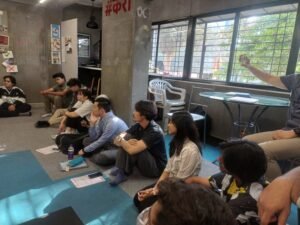
Discover how our first-year students are actively engaging in real-world business projects, guided by facilitator Sharjeel Shaikh.