What Is Experiential Learning and Why It Is the Future of Business…
Experiential learning is the fastest-growing model in business education globally — and the most misunderstood in India. Here…

May 25, 2026
Internship and apprenticeship are used as synonyms in most Indian career conversations — but they describe fundamentally different relationships between a young professional and an organisation. The difference matters enormously for career development. The wrong choice — or more accurately, the choice made without understanding the distinction — can cost a student two or three years of compounding career advantage. Here is a precise comparison of what each delivers, what each requires, and which builds a better career foundation.
A typical Indian internship lasts 1–3 months, often in the summer between academic years. The intern is given tasks — some meaningful, some administrative — and leaves with a certificate and a LinkedIn entry. The accountability is low: the intern is not responsible for outcomes, rarely manages a deliverable end-to-end, and has limited exposure to how decisions are actually made in the organisation.
Internships are valuable as introductions to professional environments — but limited as builders of transferable skill. Three months is rarely enough time to develop real functional expertise, build meaningful professional relationships, or demonstrate sustained ownership of a project.
A formal apprenticeship is a structured, extended learning relationship — typically 6–12 months or longer — in which the apprentice performs real work alongside experienced professionals, is accountable for specific deliverables, and receives structured feedback on their performance. Unlike internships, apprenticeships are governed by clear expectations for both parties: the organisation receives real work, and the apprentice receives real skill development and accountability.
In India, the National Apprenticeship Promotion Scheme (NAPS) provides a formal framework for apprenticeships with stipend support. Internationally, apprenticeship models are used in everything from engineering to management to finance as the primary route into skilled professional work.
Hiring managers across India treat internships as a baseline expectation — a candidate who has done two or three internships is not significantly differentiated from one who has done one. Apprenticeship experience, particularly multi-month placements with documented deliverables and measurable outcomes, consistently registers as a stronger signal of professional capability.
Let’s Enterprise’s Working BBA is built around 4 full apprenticeships over three years — not internships. Each apprenticeship places the student in a real company with real accountability for real deliverables, reviewed by real professionals. Students complete 13 live client projects alongside the apprenticeships, building a documented portfolio of real outcomes before graduation.
By the time a Working BBA student graduates, they have 15 months of apprenticeship experience — the equivalent of what most graduates spend 3–4 post-graduation years trying to build. The programme awards a UGC-approved BBA from DY Patil University or Pune University, starts at 17, and has 50 seats for August 2026 in Pune.
Four real apprenticeships before you graduate.
Let’s Enterprise’s Working BBA: 4 full apprenticeships, 13 live client projects, and a UGC-approved degree from DY Patil University or Pune University. The experience most graduates spend years trying to build. 50 seats, August 2026.
An internship is typically a short-term (1–3 month) exposure to a company with limited accountability. An apprenticeship is a longer, structured programme (6–24 months) in which the apprentice performs real work with real accountability and receives structured feedback. Apprenticeships build significantly deeper skills and more credible professional experience than internships.
Yes, generally. Apprenticeships build deeper functional skills, stronger professional judgment, and more credible career evidence than internships. The extended duration creates real accountability and compounding skill development that short-term internships cannot replicate. Employers consistently treat documented apprenticeship experience as a stronger hiring signal than internship experience.
Yes. The National Apprenticeship Promotion Scheme (NAPS) provides a formal framework for apprenticeships in India with stipend support. Some programmes — like Let’s Enterprise’s Working BBA — integrate formal apprenticeships directly into the degree structure, giving students 4 full apprenticeships across three years as part of their undergraduate programme.
More important than the number of internships is the depth of experience each one provides. One substantive apprenticeship of 6+ months with real accountability and measurable deliverables is worth more than three standard summer internships where the work is peripheral. Quality and accountability matter more than quantity.
Hiring managers consistently rate documented apprenticeship experience more highly than standard internship experience, particularly when the apprenticeship involved real accountability, specific deliverables, and measurable outcomes. Candidates who can describe sustained real work — not just brief exposure — in specific detail are significantly more compelling in interviews.


Experiential learning is the fastest-growing model in business education globally — and the most misunderstood in India. Here…

Most families calculate the tuition fee when budgeting for a BBA in India. The real cost is two…
Work-integrated education — earning income and building professional experience while studying for a degree — is growing fast…

Let's Enterprise is a pioneering educational institution that empowers students with hands-on business skills through its unique UG-M.E.D. program. With campuses in Pune and Goa, it bridges the gap between traditional learning and real-world experience, shaping the future of tomorrow's entrepreneurs.
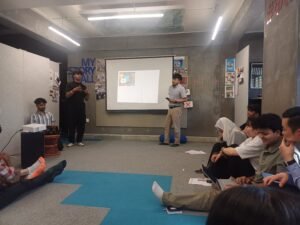
Discover how our first-year students are actively engaging in real-world business projects, guided by facilitator Sharjeel Shaikh.