What Is Experiential Learning and Why It Is the Future of Business…
Experiential learning is the fastest-growing model in business education globally — and the most misunderstood in India. Here…

May 23, 2026
Startups in India do not hire by credential. They hire by demonstrated ability — and every month you spend building that ability is worth more than any degree you could add to your CV. Here is how to enter the startup ecosystem, what founders actually look for, and why 18 is the most powerful age to start.
A 20-person startup hiring its third business person cannot afford to bet on potential signalled by a prestigious degree. The cost of a wrong hire — in time, in distraction, in team morale — is too high. So startup founders hire for demonstrated competence: evidence that you have already done something similar, shipped something real, figured out hard problems without hand-holding.
In startup hiring, a portfolio of real work — even if built independently or during an apprenticeship — outweighs an MBA from a non-IIM institution because it eliminates uncertainty about what the candidate can actually do.
The four qualities startup founders most consistently cite in strong early hires — ambiguity tolerance, action bias, commercial instinct, and founder empathy — are all developed through real work, not coursework.
The emergence of Mesa School of Business — backed by CRED founder Kunal Shah and Elevation Capital — is itself a market signal. When operators and investors of that calibre commit capital to a startup-focused business school, they are expressing a belief that the existing educational infrastructure is not producing the talent the startup ecosystem needs.
Mesa School’s backing by Elevation Capital — one of India’s most active early-stage venture funds — is an institutional vote of no confidence in the conventional MBA as a pipeline for startup talent.
The limitation is structural: Mesa is a postgraduate programme for 22-24 year olds. The insight behind it — startup-specific experiential learning is more valuable than generic business theory — is correct. The timing is late.
The single highest-leverage action for a student who wants a startup career is working inside an early-stage company before finishing their degree — not as an observer, but as a contributor with defined scope and real deliverables. Owning a growth channel, running customer interviews, managing an ops process — any of these, done well and documented, is more credible than a degree.
A CV lists credentials and job titles. A portfolio shows what you built, what you shipped, what happened when you did. Document every project: the problem, your approach, the outcome, what you learned. Make it public.
Startup hiring happens through networks before job boards. Know which funds back which types of companies, which founders have built what, and where the next wave of interesting companies is likely to emerge.
Startup events, founder communities, and accelerator demo days are where hiring decisions begin — long before a job description is written. A student who has spent two years in these rooms, contributing to conversations and being known, has a structural advantage no credential provides.
Every one of the four profile-building actions above takes time. The student who starts at 18 has three more years of compounding than the student who starts at 21 after a conventional undergraduate degree, and five more years than the student who completes an MBA at 23.
The biggest advantage available to a student who wants a startup career in India is not a better degree — it is starting three to five years earlier than the conventional educational path allows.
Early-stage startups (Seed to Series B) typically weight demonstrated competence and portfolio evidence over credentials, including MBAs. For entry and mid-level startup roles, real work experience and a visible portfolio consistently outperform a non-IIM MBA. Later-stage companies increasingly hire from structured MBA programmes for senior roles.
Offer to work on a specific, bounded problem for a startup — for free, for a defined period, with a clear deliverable. A message that says “I mapped your referral funnel and found three conversion gaps — can I spend two weeks testing a fix?” gets replies. A message that says “I want to help with your growth” does not.
Mesa’s Bangalore location, startup-focused curriculum, and backing from Kunal Shah and Elevation Capital make it a credible pathway for postgraduate students. The core limitation is timing — it is a programme for 22-24 year olds. Students who want startup-relevant experiential learning from 18 should seek undergraduate programmes that embed real startup work from day one.
If you are 17 or 18 and want to start building a startup-ready profile now — not at 23 — Let’s Enterprise offers a 3-year UGC-approved Working BBA in Pune where real apprenticeships begin in the first semester. You will graduate at 21 with a recognised degree, three years of verified professional experience, and a startup ecosystem network your peers will spend years trying to build. Learn more at letsenterprise.in.


Experiential learning is the fastest-growing model in business education globally — and the most misunderstood in India. Here…

Most families calculate the tuition fee when budgeting for a BBA in India. The real cost is two…
Work-integrated education — earning income and building professional experience while studying for a degree — is growing fast…

Let's Enterprise is a pioneering educational institution that empowers students with hands-on business skills through its unique UG-M.E.D. program. With campuses in Pune and Goa, it bridges the gap between traditional learning and real-world experience, shaping the future of tomorrow's entrepreneurs.
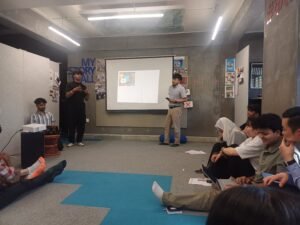
Discover how our first-year students are actively engaging in real-world business projects, guided by facilitator Sharjeel Shaikh.