What Is Experiential Learning and Why It Is the Future of Business…
Experiential learning is the fastest-growing model in business education globally — and the most misunderstood in India. Here…

May 23, 2026
Finance teams interviewing a fresh BBA hire are not asking “Do you know finance?” They are asking a harder question: “Can you be trusted with responsibility?” Most finance education prepares students for the first question and leaves them completely unprepared for the second. The gap between those two questions is where most careers stall before they begin.
Written by Anu Pazhayannur, Let’s Enterprise | May 8, 2026
A fresh BBA hire walks in with ratio knowledge, balance sheet familiarity, and a handful of case studies. Finance teams want something harder to teach: someone who can read numbers in context, make calls with incomplete data, and keep moving when things are not clean or clear.
This is where most freshers struggle. Not because they are incapable — but because they have been trained for the wrong outcome. Employer surveys and hiring manager feedback keep surfacing the same concern: graduates are educated, but not work-ready.
Finance is about looking at a set of numbers and explaining in plain language what is happening and what it means for the business. The analyst who can do that in two sentences is more useful than the one who builds a beautiful deck nobody acts on.
No one hands you a perfectly defined problem. You are expected to figure out what needs doing, ask the right questions, and move without waiting to be told. Finance leaders say this consistently: ownership matters more than technical precision. Someone who takes initiative with 80% of the information will outpace someone waiting for 100% certainty.
There is no clean dataset. Numbers will be incomplete, delayed, or conflicting. Timelines shift. Assumptions break. What matters is whether you can still form a view, make a call, and stand behind it. That ability is not a soft skill. It is the skill.
A correct answer delivered late is often useless. Finance teams want someone who can move decisions forward with reasonable judgment — not someone waiting for a clarity that never quite arrives. Done and directionally right beats perfect and delayed, almost every time.
The best analysts are not the ones who calculate the most. They are the ones who influence what happens next. This is consistently flagged as the biggest gap in fresh hires: they can do the analysis but struggle to translate it into something that actually changes a decision. Numbers that do not lead to action are just numbers.
The mistake is not lack of knowledge. Most BBA graduates know their finance reasonably well. The mistake is what they have been trained to optimise for.
Years spent focused on getting the answer right, using correct terminology, demonstrating they understood what was taught. These are the skills that earn marks. They are not the skills that earn trust.
Finance teams reward something different: taking initiative before being asked, translating analysis into a clear recommendation, thinking like someone who owns the outcome rather than someone who completed a task. The result is a graduate who knows finance but does not yet know how to use it.
In a world where AI can generate analysis in seconds, information alone is not the edge. Anyone can pull a number. Very few people can tell you what it means, why it matters, and what the organisation should do because of it.
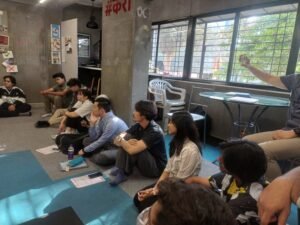
At Let’s Enterprise, this shift does not happen through lectures or assessments. It happens in the middle of doing real work, with real stakes and no guaranteed outcomes.
In the Kickstart Project, students are not solving finance problems — they are making financial decisions. With limited money and no safety net, every choice carries weight: what to spend, what to hold, what to test. The outcome is not a grade. It is profit or loss. That difference changes everything about how you approach a decision.
In client projects, students track costs, conversions, pricing, and margins — not to report them, but to recommend what should change. The question is never “What is the number?” It is always “What should we do next?”
Research consistently shows this: students who engage with real projects, live clients, or apprenticeships adapt faster in professional environments because they have already dealt with ambiguity, accountability, and consequences before their first day on the job. Experience does not just add to knowledge. It changes how knowledge gets used.
Finance roles are changing faster than most curricula are. They are no longer about maintaining reports — they are about enabling decisions. Not just accuracy, but relevance, speed, and clarity under pressure.
There is a version of your career where you become technically capable: someone who runs the numbers, produces the output, and hands it upward. That version is safe. It is also increasingly replaceable.
And there is another version — one where you become the person a team actually relies on. Not just to calculate, but to think. Not just to report, but to recommend. Not just to do the work, but to own what comes from it.
The difference between those two versions is not a course or a certification. It is whether you have been in a situation where the outcome was real, the stakes were yours, and no one was going to save you from a bad call.
Ready to build judgment, not just knowledge?
Let’s Enterprise’s Working BBA puts you inside real finance decisions — live client projects, apprenticeships, and business outcomes that belong to you. 50 seats. August 2026 cohort.
Finance teams look for ownership, clarity of thinking, comfort with ambiguity, speed of judgment, and communication that drives action — not just technical knowledge of ratios and financial statements. Hiring managers consistently flag that graduates are educated but not work-ready because they have been trained to get answers right rather than to make decisions under pressure.
Most BBA graduates struggle in finance jobs not because they lack knowledge, but because they have been optimised for the wrong skills. Academic training rewards getting the right answer with complete information. Finance teams reward taking initiative with incomplete information, translating analysis into recommendations, and owning outcomes — skills that classroom education rarely builds.
Finance knowledge is the ability to calculate ratios, read balance sheets, and understand financial concepts. Finance judgment is knowing what matters in a specific situation, what to ignore, and what the organisation should do because of a number. Judgment develops through real decisions with real consequences — not through studying more carefully.
Experiential learning places students inside real financial decisions — tracking live costs, managing actual budgets, and recommending changes to real clients — before their first job. Research shows students who engage with live projects and apprenticeships adapt faster in professional environments because they have already practised ambiguity, accountability, and ownership with real stakes.
A BBA degree is necessary but no longer sufficient for finance roles in India in 2026. With AI handling routine analysis, employers prioritise candidates who demonstrate judgment, initiative, and the ability to communicate financial insights into actionable decisions. Practical experience — through apprenticeships, live client projects, or programmes like Let’s Enterprise’s Working BBA — is increasingly what differentiates hireable candidates.


Experiential learning is the fastest-growing model in business education globally — and the most misunderstood in India. Here…

Most families calculate the tuition fee when budgeting for a BBA in India. The real cost is two…
Work-integrated education — earning income and building professional experience while studying for a degree — is growing fast…

Let's Enterprise is a pioneering educational institution that empowers students with hands-on business skills through its unique UG-M.E.D. program. With campuses in Pune and Goa, it bridges the gap between traditional learning and real-world experience, shaping the future of tomorrow's entrepreneurs.
Discover how our first-year students are actively engaging in real-world business projects, guided by facilitator Sharjeel Shaikh.