What Is Experiential Learning and Why It Is the Future of Business…
Experiential learning is the fastest-growing model in business education globally — and the most misunderstood in India. Here…

May 23, 2026
The Unstop Talent Report 2026 just published the price tag on a fresher’s degree. 40% of companies pay BTech freshers under ₹7 LPA. 25% of employers don’t hire non-engineering undergraduates at all. These numbers are not a bad year. They are the trend line — and they have been for six years.
The Unstop Talent Report 2026 surveyed 500+ HR professionals between January and February 2026. Half the sample came from technology, consulting, and BFSI/fintech. 36% of the firms employed more than 2,000 people. Here is what they pay India’s freshers in 2026:
Read those numbers slowly. Then read them again.
A four-year engineering degree — ₹8–25 lakh in tuition, hostel, coaching, and opportunity cost — has a ~40% chance of converting into a salary lower than what a competent freelance content writer makes in their second year.
A three-year general BBA/BCom (at least ₹3–10 lakh all-in) has a 25% chance of being treated, at hiring time, as if it does not exist. This is not a bad year. This is the trend line.
If the Unstop report were the only data point, you could call it a sampling fluke. It isn’t.
The degree, on its own, is no longer a usable signal of work-readiness. Employers know this. HR teams know this. Students suspect it. Parents are the last to find out, usually at the placement office.
Open any traditional BBA brochure in India. Count the months of actual, paid, deadline-bearing, manager-judged work the student will do in three years.
Usually 2 to 8 weeks. Often unpaid. Almost always “summer projects” graded on the report, not the outcome. Then count the months of theory: ~30 months.
We then hand the student a degree, send them to a placement drive, and act surprised when an HR manager who has interviewed 80 candidates that morning offers ₹3.5 LPA — because the only thing she can verify in 25 minutes is that the candidate has no proof of having ever shipped anything.
This is not a failure of “students these days.” It is the entirely predictable output of a college experience that allocates 95% of its time to information transfer and 5% to evidence creation, in an economy that hires almost exclusively on evidence.
The fix is not “add more theory.” It is not “add an online certificate.” It is not “make the placement cell call more companies.” The fix is to invert the ratio.
Most people frame doing-things-differently after 12th as “the risky option”: non-mainstream, non-traditional, untested. We think that framing is backwards.
If you accept the data above, then continuing to spend ₹8 lakh and three irreplaceable years on a course that produces a 25% chance of being told “we don’t hire your category” is the riskier bet. The default option is the gamble. The Working BBA is the audit.
Let’s Enterprise is a practical business college in Pune. Not a coaching institute. Not an online programme. We are the place an 18-year-old goes when they want the next three years to build a body of work, not a transcript.
Our flagship is the Working BBA — a 3-year programme where real work (apprenticeships, client briefs, business challenges, and a public portfolio) is the curriculum. Classroom is the supporting layer, not the main event. Students complete their UGC-approved BBA degree alongside, through a partner online university, so they leave with the same recognised credential a traditional college issues. The difference is what they leave with in addition to the degree.
Over three years, a Working BBA student completes:
A Working BBA student doesn’t graduate with a CGPA and a placement-cell prayer. They graduate with a degree, 15 months of verifiable work history, a portfolio of shipped work, and four ex-managers who can vouch for them by name.
That’s a different conversation in an HR room. Not a better answer to the same question. A different question entirely.
The Working BBA is not for everyone, and we say so before anyone pays a rupee. Our admissions process is built around four signals — what we call demonstrated HUNGER:
We reject more candidates than we accept. The cohort cap for August 2026 is 50 seats.
This isn’t a marketing line. It is the reason the model works. A college built around real work only delivers if the student is, on day one, the kind of person who can be trusted with real work.
According to the Unstop Talent Report 2026 — a survey of 500+ HR professionals — 40% of companies pay BTech freshers under ₹7 LPA, with 16% paying under ₹5 LPA. Only 5% of employers pay engineering freshers above ₹20 LPA, and 10% of companies do not hire BTech freshers at all.
The Aspiring Minds / Mercer Mettl National Employability Report found fewer than 1 in 5 engineering graduates is employable for a software role. The root cause: traditional colleges allocate roughly 95% of programme time to theory and 5% to real work — producing graduates with no verifiable evidence of having shipped anything, in a job market that hires almost exclusively on demonstrated output.
The Working BBA is a 3-year programme at Let’s Enterprise in Pune where real work — 4 apprenticeships totalling 15 months, 13 client projects, and a public portfolio — is the curriculum. Students complete a UGC-approved BBA degree in parallel. Unlike a traditional BBA, graduates leave with verifiable work history and a portfolio of shipped work, not just a CGPA.
If you are a parent, an 11th or 12th grader, an HR leader tired of the same conversation, or an educator who knows the current model is broken — share this. Not because of Let’s Enterprise. Because the data in the Unstop Talent Report 2026 should not need a college’s marketing team to put it in front of Indian parents. It should already be on the first page of every BBA brochure.
If you want to look at our programme more closely: letsenterprise.in/program
Sources: Unstop Talent Report 2026 (Jan–Feb 2026, 500+ HR professionals); India Skills Report (Wheebox/CII/AICTE); Aspiring Minds / Mercer Mettl National Employability Report for engineers; Naukri JobSpeak; LinkedIn Workforce Confidence Index for India.


Experiential learning is the fastest-growing model in business education globally — and the most misunderstood in India. Here…

Most families calculate the tuition fee when budgeting for a BBA in India. The real cost is two…
Work-integrated education — earning income and building professional experience while studying for a degree — is growing fast…

Let's Enterprise is a pioneering educational institution that empowers students with hands-on business skills through its unique UG-M.E.D. program. With campuses in Pune and Goa, it bridges the gap between traditional learning and real-world experience, shaping the future of tomorrow's entrepreneurs.
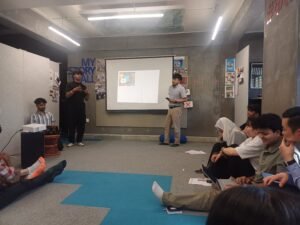
Discover how our first-year students are actively engaging in real-world business projects, guided by facilitator Sharjeel Shaikh.